Vladimir Semyonovitch
The DoubleVladimir Semyonovitch is the nephew of Andrey Filippovitch and a young official whose rank, family connections, and courtship of Klara Olsufyevna place him at the center of the birthday festivities at Olsufy Ivanovitch’s house. His public ascent supplies a sharp counterpoint to Yakov Petrovitch Golyadkin’s social collapse: while Vladimir is toasted, admired, and welcomed into the dance, Golyadkin struggles to secure even a respectable place in the room.
Identity and Public Standing
Vladimir is described as twenty-six and already an assessor, a rank the narrator pointedly sets against his youth. He is Andrey Filippovitch’s nephew, and the kinship is made conspicuous at a celebration where Andrey speaks before the assembled guests. His official status is not merely background: in the narrator’s mock-grand account, Vladimir’s appearance and assessorial rank seem to announce how high a man may rise through morality and good principles. The irony belongs to the narrative’s extravagant praise, which makes the ceremony’s social judgments visible even as it performs them.
The birthday gathering gives Vladimir a place among the household’s honored circle. Olsufy Ivanovitch is the host; Klara, his daughter and the evening’s “queen,” receives the guests’ attention; and Andrey Filippovitch, head of the office in which Golyadkin serves, is both Vladimir’s uncle and one of the principal speakers. Vladimir’s position thus joins bureaucratic advancement to family association and access to an elite domestic celebration.
The Birthday Toast
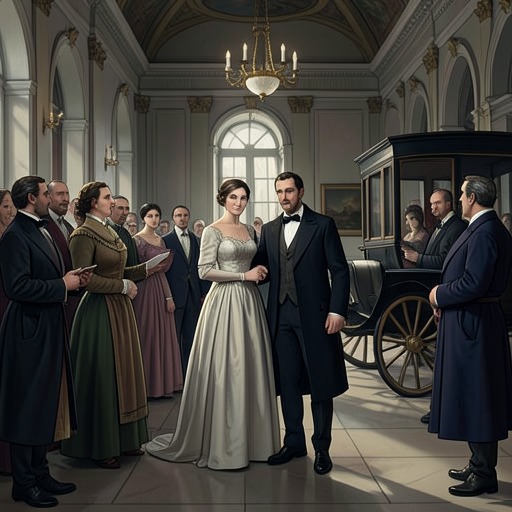
After Andrey Filippovitch has raised a glass and delivered his congratulations, Vladimir rises in his turn to propose a toast. The guests’ eyes settle on him: the parents look tearfully toward him, Andrey with pride, Klara with modesty, and the other guests with solemn attention. Even some of the younger officials watch with decorous envy. The scene makes his public recognition collective; the company’s gaze confirms the standing his family tie and rank already suggest.
The narrator treats Vladimir’s speech as part of an elaborate tableau of virtue and advancement. He declines to describe the moment in genuinely “lofty” language, while surrounding the young man with ceremonial admiration and linking his assessorial rank to morality and good principles. That gap between the narrator’s mock-sublime manner and the event’s social form makes Vladimir less a psychologically developed portrait than a figure of recognized success: he is what the gathering can praise, display, and reward.
Courtship and the Dance
Vladimir’s place in the celebration is also romantic. Golyadkin reports to Krestyan Ivanovitch that, at an earlier gathering at Olsufy Ivanovitch’s, he had spoken critically to Vladimir about his recent promotion and his wish to marry while still very young. Golyadkin also recalls turning to Klara after she had sung, implying that her song had not been heard with a pure heart and that others were now looking higher. The report is Golyadkin’s own account of his intervention, but it establishes how he interprets Vladimir’s courtship: as a conspicuous match that he has tried to rebuke or interrupt.
At the birthday festivities, Vladimir leads the polka with Klara. The dance is a fashionable novelty that has captured the guests’ interest, and the couple’s place at its head makes their association visible to the whole company. When Golyadkin later approaches Klara and tries to take her hand for a dance, the crowd rushes to separate them and carries him away. Vladimir’s successful dance and Golyadkin’s failed approach occur within the same celebration, turning courtship into a public contrast between accepted intimacy and an intrusion the company will not permit.
Contrast with Golyadkin and the Ending Image
Vladimir’s prominence becomes especially pointed because Golyadkin’s attempt to speak at the celebration is met with silence, laughter, and rebuke. After Golyadkin stammers through his congratulations, Andrey Filippovitch turns away from him and gives Klara his arm; Golyadkin retreats to a corner and tries to present himself as an indifferent spectator. Against that humiliating retreat, Vladimir’s toast and dance proceed with the approval of the room. The contrast does not require Vladimir to attack Golyadkin: his accepted place among the guests is enough to intensify Golyadkin’s sense of displacement.
In the novel’s later framing of the gathering, Vladimir appears beside Klara at Olsufy Ivanovitch’s easy chair, dressed in black and wearing a new order in his buttonhole. Klara stands on the other side, pale and melancholy, with a small white flower in her hair; Andrey Filippovitch is also present, solemn, and Golyadkin’s younger double is nearby in an air of decorum. The arrangement places Vladimir once again beside Klara and among the people directing the scene, while Golyadkin is led toward the chair under their gaze. Across the celebration, Vladimir’s defining narrative function is therefore relational and social: he stands at the intersection of office rank, family favor, and courtship, embodying the public recognition that Golyadkin seeks and cannot obtain.